
Certainty in an Uncertain Environment
How a new Fed chair, record bond issuance and shifting market dynamics are reshaping the fixed income landscape.
Liquidity is like oxygen – you never think about it until you need it.
New Fed Chair and Implications for Interest Rates
Kevin Warsh’s ascension to Chairman of the Federal Reserve in May 2026 marked a notable inflection point for U.S. monetary policy, both stylistically and substantively. A former Fed governor and longtime critic of certain post-financial crisis policy frameworks, Warsh has assumed leadership at a particularly challenging moment—one defined by a sharp jump in already above-target inflation data, strong employment numbers and heightened geopolitical uncertainty.
From the outset, Warsh has emphasized institutional reform and a reevaluation of the Fed’s policymaking process and communication strategy. As an example, the June 2026 Federal Open Market Committee (FOMC) statement under Warsh was notably shorter—only around 130 words in length versus previous statements that averaged more than 300 words. The new statement focused solely on current economic data, removed all forward guidance and ended with a terse prediction that “The Committee will deliver price stability.”
Minimalism appears to be a top priority and a deliberate pivot away from the transparency-heavy framework that defined the Bernanke, Yellen and Powell eras. Notably, with annualized U.S. inflation running above 3% for most of the past five years, and with recent energy shocks and geopolitical developments adding further pressure, Warsh’s first statement as chief was explicit that the Fed’s inflation goal remains 2%.
From the outset, Warsh promised “regime change” and a desire to “rethink” the central bank’s operating framework. To that end, Kevin Warsh is leading a comprehensive rethink of how the Fed designs and executes monetary policy. Based on his first FOMC meeting and subsequent remarks, we now know there are task forces organized around the following five core areas:
- Fed communications framework
- Economic data and measurement
- Inflation framework and drivers
- Technology / AI effects on jobs and productivity
- Balance sheet size and composition
While this massive rethink may give policymakers greater flexibility in responding to evolving economic conditions, it also introduces a higher degree of uncertainty for bond markets, which have grown accustomed to clear signaling via tools like the interest rate dot plot and frequent verbiage outlining coming moves. Looking ahead, this structural reorientation of monetary policy under Warsh may bring less clarity about the direction of U.S. interest rates and even surprises in the short term. This adds to the broader theme of higher market uncertainty, at least for now.
Heavy Bond Issuance Continues
New bond issuance in the United States has accelerated to record levels in 2026, underscoring the extraordinary scale of domestic bond markets. At approximately $80 trillion in outstanding securities, the U.S. fixed income market is now comparable in size to the entire U.S. equity market. It remains the deepest and most liquid bond market globally, anchored by the U.S. Treasury market, which alone accounts for nearly half of all outstanding debt. This dominance reinforces the central role of Treasurys as the global benchmark for risk-free rates and the foundation for pricing other debt securities.
Figure 1 below reveals the rapidly expanding U.S. Treasury debt, which reached more than $39 trillion as of mid-2026, an increase of nearly $700 billion year-to-date. The surge reflects a continuation of the structural upward trajectory that has taken hold over the past decade. Total Treasury debt has increased by about 70% from pre-COVID levels in 2019. While earlier periods of debt accumulation were largely episodic, driven by specific upheavals like wars or the Great Recession, the current environment is characterized by persistent, abnormally large fiscal deficits.
The composition of Treasury issuance has also shifted substantially, with T-bills less than one year to maturity now totaling roughly $6.2 trillion. This increased reliance on short-dated issuance may reflect a combination of factors, including increasing structural demand from money market funds and financial institutions. However, this strategy introduces elevated rollover risk, as a larger share of the debt must be refinanced continuously in the open market. This also ties total Treasury interest expense closer to overnight rates, which have risen sharply in the past few years as a consequence of higher inflation.
Corporate bond issuance has matched this surge in activity, with the U.S. investment-grade market opening 2026 at an unprecedented pace. Through the first four months of the year, issuance reached a record $767 billion, driven largely by front-loaded borrowing from hyperscalers and large financial institutions.
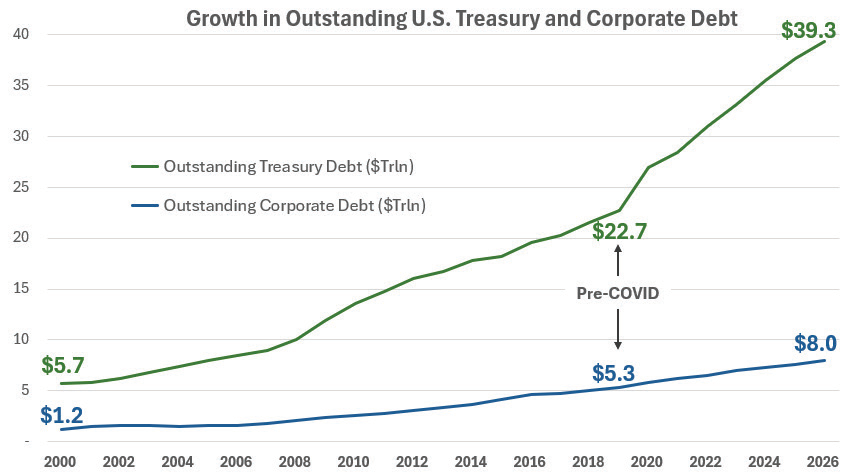
Figure 1. Growth in Outstanding U.S. Treasury and Corporate Debt. Source: Baird Trust, Bloomberg LLC, fiscaldata.treasury.gov.
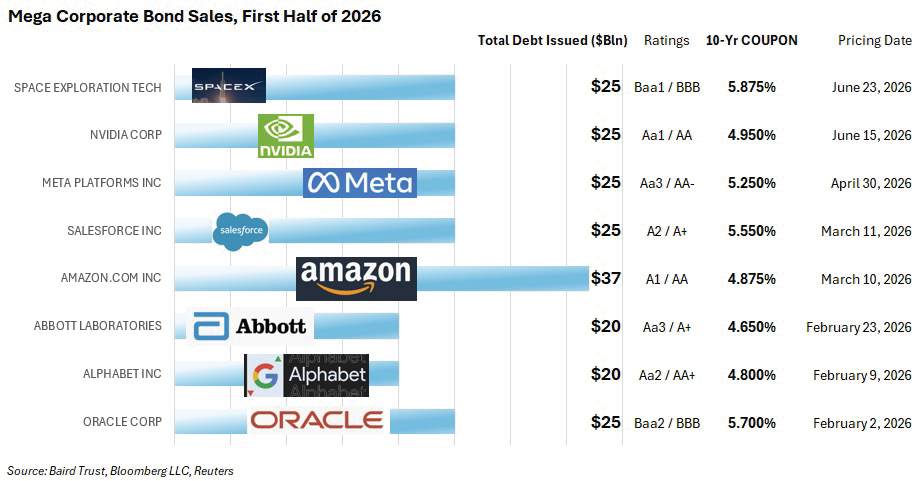
Figure 2. Mega Corporate Bond Sales, First Half of 2026. Source: Baird Trust, Bloomberg LLC, Reuters.
Some Certainty in Uncertain Times
As outlined in Figure 2, major transactions by companies such as Amazon, Alphabet, Meta and Nvidia have highlighted the scale of funding required to support ongoing investment in artificial intelligence and infrastructure, with individual deals ranging from $25 billion to over $35 billion and often attracting multiple times that amount in investor demand. While the Treasury market remains five times larger, corporate bond issuance is growing rapidly in relative terms, reinforcing the broader expansion of U.S. dollar-denominated credit markets.
The start of 2026 has been defined by a high degree of macroeconomic and geopolitical uncertainty, leaving markets without a clear directional anchor. Elevated inflation pressures and bond issuance, shifting expectations around a new Fed Chair and persistent fiscal imbalances have combined to create an ambiguous economic backdrop. At the same time, geopolitical tensions—particularly those affecting energy markets and global supply chains—have added further complexity to the outlook. As a result, investors have been forced to navigate a landscape where forward-looking visibility is notably limited.
Despite this uncertain environment, volatility across asset classes has diverged meaningfully. While U.S. equity markets have experienced elevated price swings, the U.S. bond market has exhibited comparatively subdued volatility, with yields moving in a more measured and orderly fashion in 2026. This relative stability reflects consistent demand for income and high-quality bonds like those found in Baird Trust portfolios. Now more than ever, bonds are delivering their stabilizing force within portfolios, even amid broader uncertainty across global financial markets.
Yet this lower volatility viewed in isolation can be a deceptive measure—liquidity matters too. Investors recently lured to illiquid asset classes like private credit by promises of low volatility and attractive returns have found their money locked up behind redemption gates. As fund after fund has suspended or limited redemptions, investors have found out the hard way that liquidity is like oxygen—you never think about it until you need it. This underscores our philosophy at Baird Trust of investing in liquid bonds that can provide our clients with their funds when they are needed, thereby delivering a measure of certainty in these very uncertain times.
CFP Board owns the marks CFP®, CERTIFIED FINANCIAL PLANNER®, and CFP® (with plaque design) in the U.S.
Baird Trust Company (“Baird Trust”), a Kentucky state- chartered trust company, is owned by Baird Financial Corporation (“BFC”). It is affiliated with Robert W. Baird & Co. Incorporated (“Baird”), (an SEC-registered broker dealer and investment advisor), and other operating businesses owned by BFC. Past performance is not a predictor of future success. All investing involves the risk of loss and any security may decline in value. This is not intended as a recommendation to buy any security and views expressed may change without notice. Baird Trust does not provide tax or legal advice. This market commentary is not meant to be advice for all investors. Please consult with your Baird Financial Advisor about your own specific financial situation.
©Robert W. Baird & Co. Incorporated.